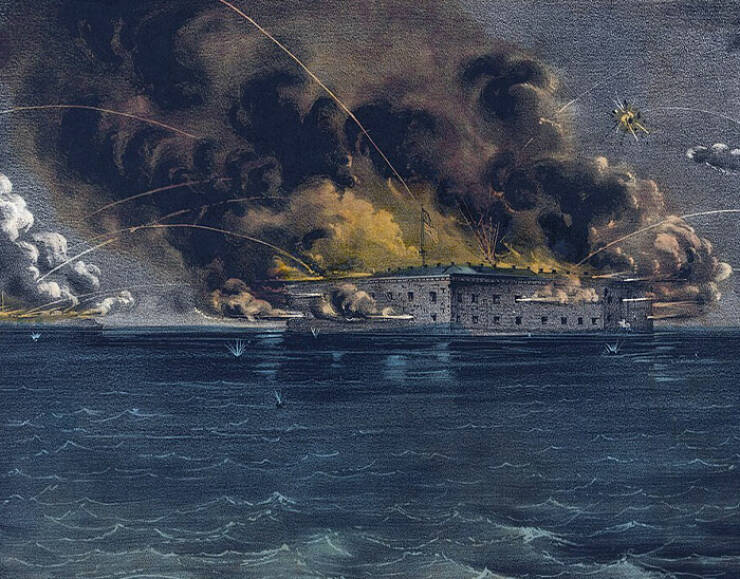
The first shots of the Civil War were not during the Siege of Fort Sumter, but rather many days before that when a battery along the shore approach to Charleston harbor, manned by Citadel cadets, opened fire on the Union steamer Star of the West, which had been dispatched to provide supplies and reinforcements to Fort Sumter. The cannonfire hit the ship but did no signicant damge, however the steamer turned and retreated. It's possible that if the ship had continued, it would have been fired on further, or if it had completed its mission, the Union soldiers in the Fort might have attempted to hold out for more time, which might have resulted in casualties on both sides. In reality, there were zero casualties during the fight and the fort was turned over to the South with a complete ceremony.
Contrary to popular belief, the US never imposed an oil embargo against Japan prior to Pearl Harbor. FDR was under a lot of pressure to apply an embargo. In a July 1941 cabinet meeting, he worried about how to explain oil rationing in California while still supplying Japan with oil. He insisted on this course of action, because he foresaw that an oil embargo could only lead to war. (The League of Nations had ruled that an oil embargo was a valid *cassus belli* when several nations tried to apply one against Italy for her invasion of Abyssinia/Ethiopia.)What the US did instead was insist that Japan pay for her oil with "new" money, rather than from Imperial accounts which had been frozen. This demand seemed to confuse Japan, but they sent a single ship to test this new arrangement. The *Tatuta Maru* had been promised that it could come to the US without fear of seizure. Once the *Tatuta Maru* docked, private parties filed suit in US courts, claiming ownership of her cargo. They filed a lien against the ship, holding it in harbor. Japan released the cargo, and the ship was allowed to sail. But Japan never attempted to purchase any further oil from the US.
Napoleon was a warmonger (he never started a war, the monarchies of Europe simply didn't like the idea of a Republic), the Sphinx's nose was shot off by Napoleon (it was pried off for not being muslimy enough in the 14th century). There are very few mysteries involving the pyramids of Egypt, and those that do exist surround Sneferu's not the famous pyramids at Giza. Swords weren't heavy, they were about 3 lbs on average (perhaps heavy for urbanite redditors). European martial arts were every bit as refined and advanced as Asian examples.
No ancient source exists that says the Romans, under Scipio Aemilianus Africanus, plowed over and sowed the city of Carthage with salt after sacking it.The salting of the earth at Carthage was invented in later stories strongly suggesting it never happened. Also, given that salt was a precious commodity during the Roman Republic/Empire it seems very unlikely that it would be used in such a way.




Exactly - Lack of written sources === The Dark Ages.

#3 Study of Ur and other cities in modern Iraq point to a very different interpretation, that until they were able to store grains and cereals, civilization could not happen. People were too concerned about scrounging for food to put energy into building a society or government or religion or anything else.
Actually, a lot of what is posted here by whoever this is, is false, misrepresents, or needs further context. No citations other than "Trust me, I'm the internet". Drivel.

Until humans were able to use fire for themselves they used almost all of their energy by looking for and consuming food.
Is also a theory, like a lot of other 'findings'.

All religion keeps people in the "Dark Ages." Especially, Islam.



Congratulations to you!
Exactly - Lack of written sources === The Dark Ages.
#3 Study of Ur and other cities in modern Iraq point to a very different interpretation, that until they were able to store grains and cereals, civilization could not happen. People were too concerned about scrounging for food to put energy into building a society or government or religion or anything else.
Actually, a lot of what is posted here by whoever this is, is false, misrepresents, or needs further context. No citations other than "Trust me, I'm the internet". Drivel.
Until humans were able to use fire for themselves they used almost all of their energy by looking for and consuming food.
Is also a theory, like a lot of other 'findings'.
All religion keeps people in the "Dark Ages." Especially, Islam.
Congratulations to you!