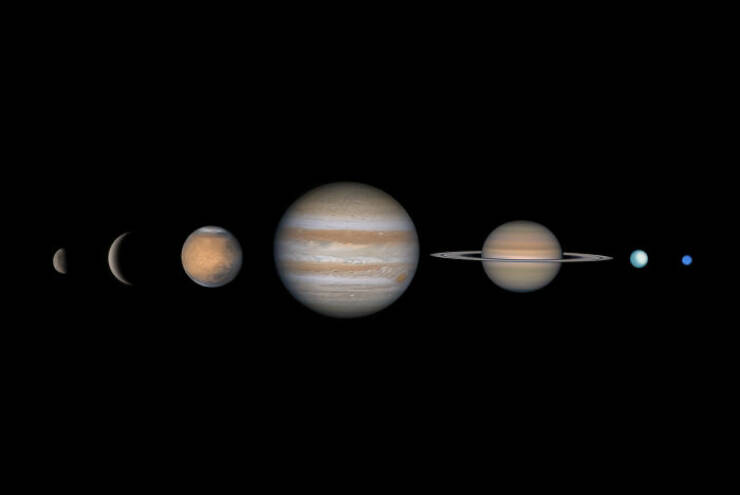
"Solar System Portrait" By Sophie Paulin
"This image presents all the planets of our Solar System, excluding Earth, showcasing their unique characteristics. Mercury, the closest to the Sun, is a barren, cratered world, while Venus is shrouded in thick clouds. Mars, the Red Planet, has vast deserts and the largest volcano in the Solar System. The gas giants, Jupiter and Saturn, dominate with their immense size and swirling storms, while Saturn’s rings make it especially striking. Uranus and Neptune, the ice giants, are rich in methane, giving them their blue hue."
Taken with a Spacewalk Telescopes Horizon 20" f/3.2 Dobsonian, Tele Vue 5x 1.25" Powermate, Spacewalk Telescopes EQ-Platform ‘Trackie’, Player One Astronomy Uranus-C camera, thousands of <10-millisecond exposures.
Location: Bobingen, Bavaria, Germany, 11 September 2023, 7 September, 29 August and 28 December 2024
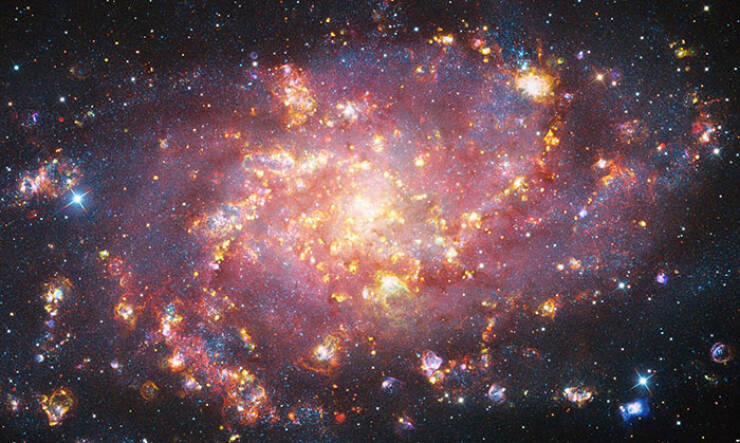
"Fireworks" By Bence Tóth, Péter Feltóti, Bertalan Kecskés
"The image shows M33, the Triangulum Galaxy from a new perspective. Due to tidal interaction with M31, there is very prominent star-forming activity in M33, which results in a spectacular structure of emission nebulae. During processing, a separate SHO picture was created with a strong SII/H-alpha presence, the glowing red structures in the picture, and blended with a high-resolution LRGB processing of the continuum data, representing the ‘background’ light."
Taken with a custom-built 250/1000 Newtonian astrograph and Lacerta 300/1200 Photo Newtonian telescope, Antlia V-Pro LRGB and 3 nm H-alpha, OIII and SII filters, Astronomik LRGB and 6 nm H-alpha, OIII and SII filters, Sky-Watcher EQ8-R Pro mount, ZWO ASI2600MM Pro and ASI294MM Pro cameras,1,000 and 1,200 mm f/4, 8.4-hour L exposures, 6.8-hour R exposures, 6.7-hour G exposures and 6.3-hour B exposures, 39.3-hour H-alpha exposures, 15.3-hour OIII exposures, 28.3-hour SII exposures.
Location: Sződliget, Pest and Törökkoppány, Somogy, Hungary, 2–4, 9, 23,30 November, 1, 27 and 28 December 2024
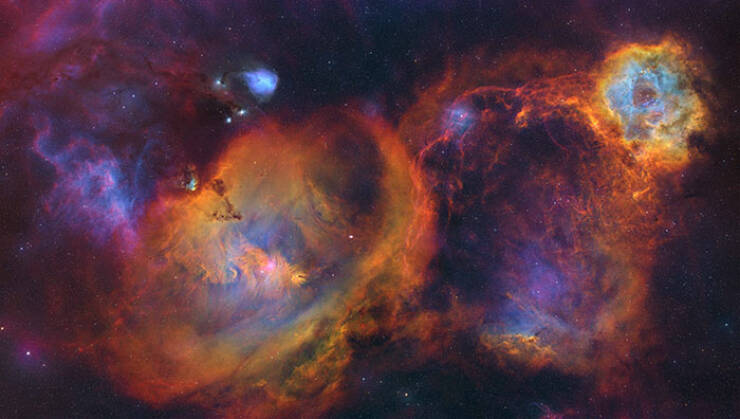
"A Rainbow Mosaic Of The Rosette And The Christmas Tree Nebulae" By Shaoyu Zhang
"This work consists of two mosaics, each panel exposed for 75 hours, capturing numerous popular targets. It highlights the Rosette Nebula and Christmas Tree Nebula, both symbols of beauty. The image supports multiple viewing angles, offering fresh experiences with clockwise, anticlockwise and vertical flips."
Taken with a Takahashi FSQ-106EDXIII telescope, Astrodon LRGBHSO filters, 10Micron GM 2000 HPS mount, Moravian Instruments G4-16803 camera, 382 mm f/3.6,150 hours total exposure.
Location: Deep Sky Chile Observatory, Camino del Observatorio, Río Hurtado, Chile, 6– 13, 22– 29 November, 1– 9, 12, 13, 18– 24 December 2024
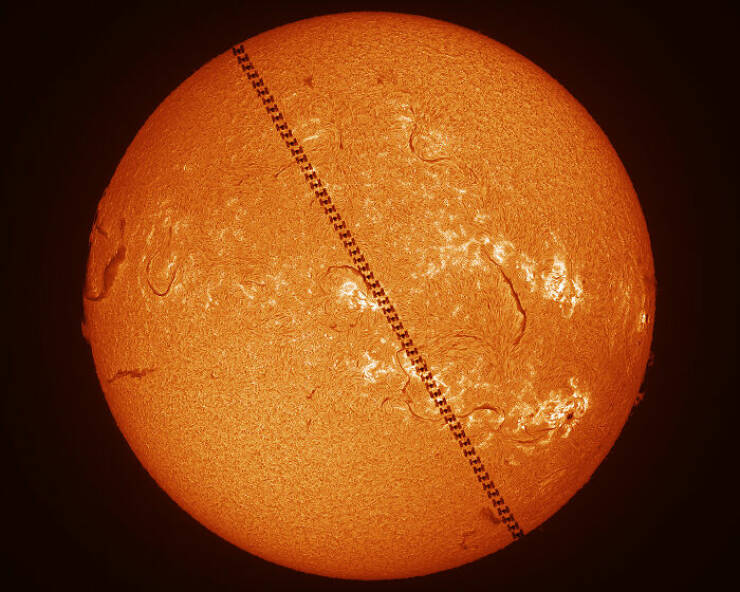
"Encounter Within One Second" By Zhang Yanguang
"This image captures the International Space Station (ISS) transiting across the solar disc. The solar background was captured separately with double-stacked etalon[an optical filter that isolates specific wavelengths, used to observe solar details], and reveals high-contrast chromospheric details. The imaging sequences were strategically combined during post-processing to preserve both the spacecraft’s crisp silhouette and the Sun’s intricate surface features."
Taken with a Takahashi Teegul 60 telescope, Coronado SolarMax 60 double stacked, Vixen polaris mount, Player One Astronomy Neptune-M camera, 500 mm f/8.3, 0.3-millisecond exposure.
Location: Xiamen, Fujian, China, 24 January 2025
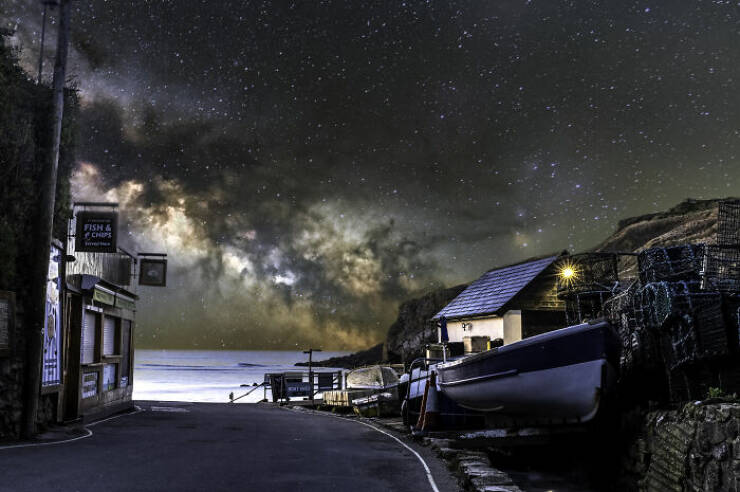
"Galactic Catch: Salt And Vinegar With Your Cosmos?" By Paul Joels
"The Milky Way arcs over Lulworth Cove, where just a short walk from the water’s edge, there’s a fish and chip shop, boathouse, and a little boat that sit quietly at night."
Taken with a CanonR6 Mark II camera, Benro Polaris mount, Foreground: Tamron 24-70 mm lens, 38 mm f/22, ISO 800, 3.2-second exposure, Sky: Samyang 14 mm lens,14 mm f/2.8, ISO 3,200.
Location: Lulworth Cove, West Lulworth, Dorset, UK, 16 March 2024
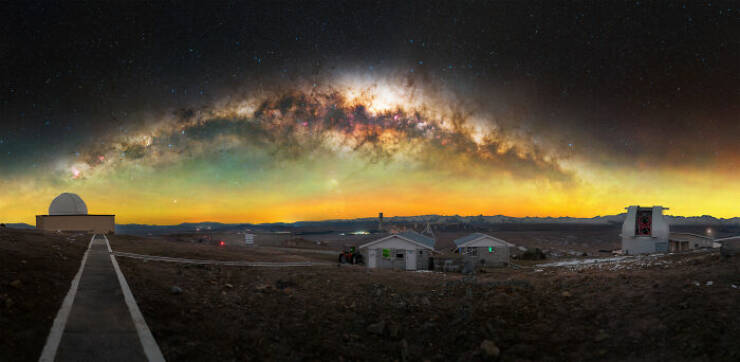
"Looking Beyond" By Chester Hall-Fernandez
This image shows the western view from "Mount John Observatory, New Zealand’s premier optical observatory. To the right is the MOA-II telescope, the largest telescope in the country. Due to the southern hemisphere location of the observatory, the Milky Way sets in parallel to the horizon, which allows for striking compositions."
Taken with a Nikon Z 6 camera, Sky-Watcher Star Adventurer mount, 35 mm f/1.4, ISO 1,600, 25-panel mosaic.
Location: Mount John Observatory, Mount John, Lake Tekapo, New Zealand, 21 July 2024
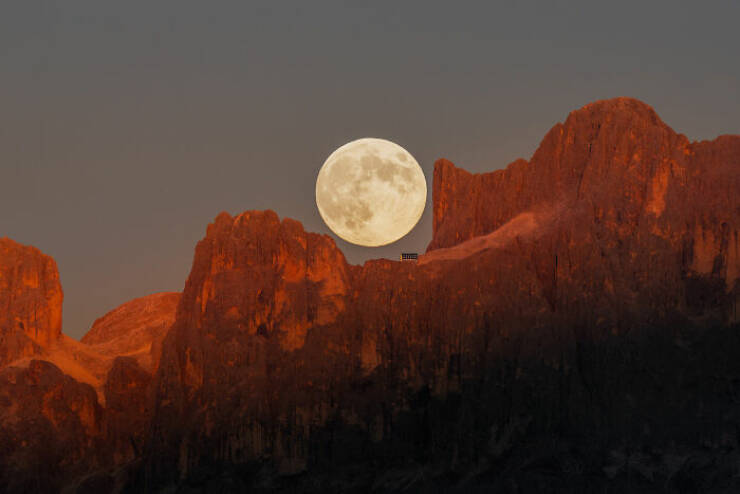
"Moonrise Perfection Over The Dolomites" By Fabian Dalpiaz
"The full Moon rising above the rugged peaks of the Dolomites. With no clouds in sight and in flawless conditions, the golden light of sunset bathes the mountains, creating harmony between Earth and sky."
Taken with a Sony Alpha 7R V camera, 400 mm f/9, ISO 320, 1/200-second exposure.
Location: Santuario di Pietralba, Deutschnofen, South Tyrol, Italy, 15 November 2024
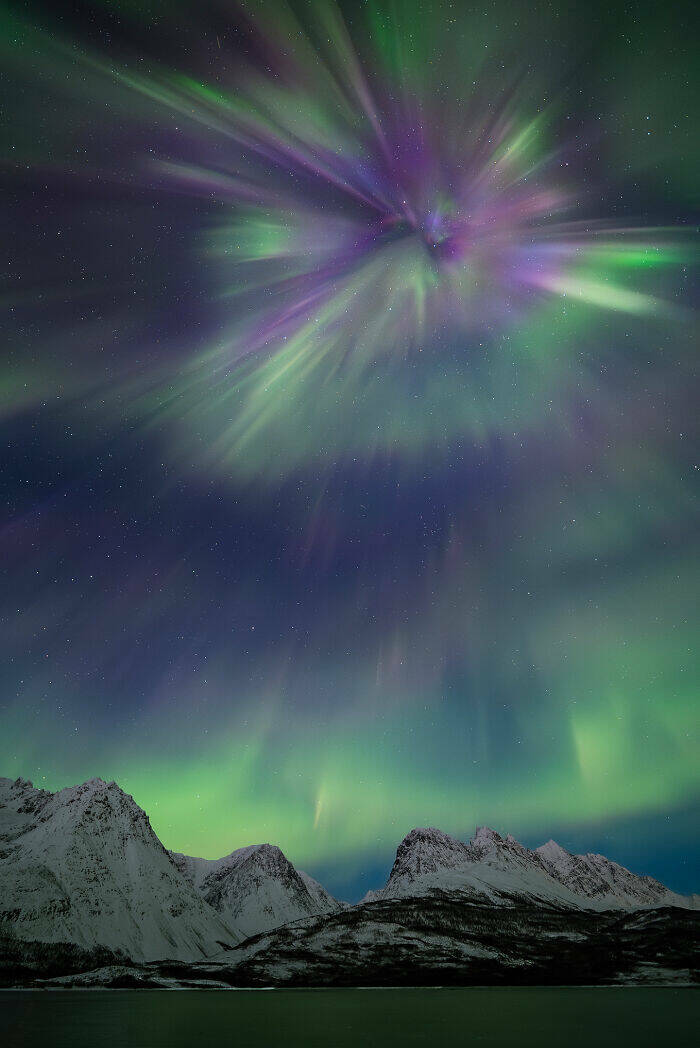
"The Arctic Flower" By Vincent Beudez
"In April, there is no ‘true’ night in northern Norway. This is why the Northern Lights look much more blue than usual. Vincent Beudez captured the visually pleasing aurora shape above the Norwegian background."
Taken with a Sony Alpha 7S III camera, 14 mm f/1.8, ISO 4,000, 1.3-second exposure.
Location: Sjursnes, Tromsø, Troms, Norway, 4 April 2024
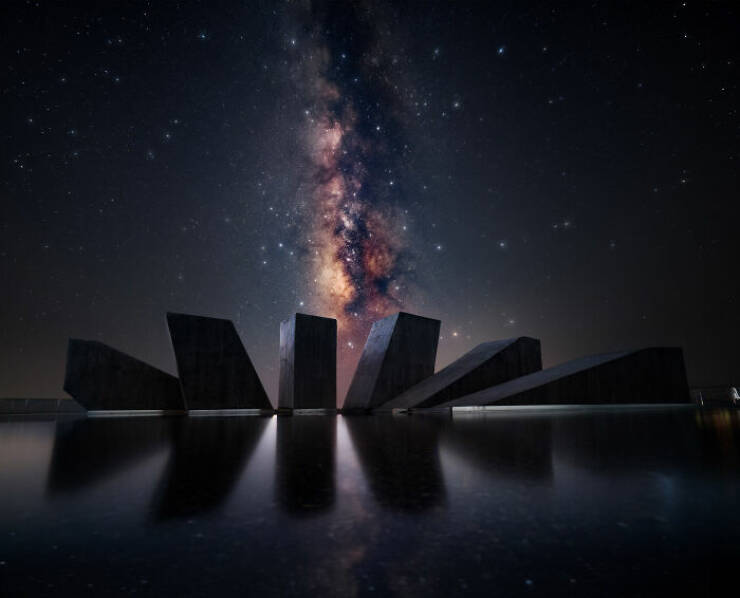
"Gateway To The Galaxy" By Yujie Zhang
"Under the night sky, several black geometric buildings appear to stand on the water’s surface, resembling gateways to the galaxy. The bright Milky Way stretches across the sky behind them, with stars twinkling. The reflections of the buildings shimmer in the water, blending reality and illusion, as if opening a passage to the mysteries of the Universe, inspiring endless reverie and a longing to explore the vast starry sky."
Taken with a Nikon Z 8 camera, 15 mm f/4, ISO 2,000, multiple 480-second exposures.
Location: Songyang County, China, 10 August 2024
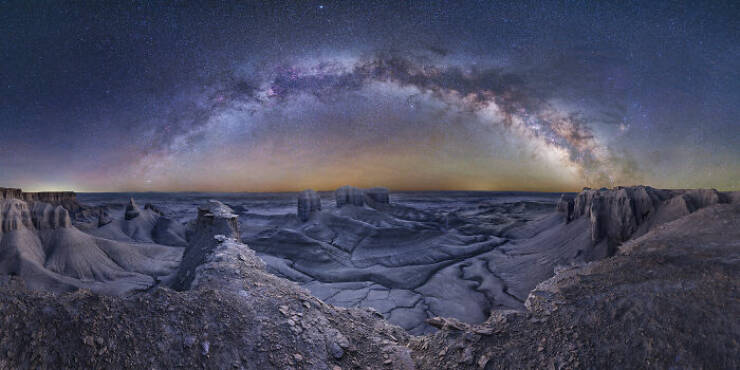
"Into The Past" By Jim Hildreth
"This impressive panorama is a view from the Utah desert. 23,000 pixels wide, the photograph shows the desolate, character rich landscape, below a starry Milky Way."
Taken with an astro-modified Canon EOS R and EOS R5 cameras, 28mm f/2.8 and f/8, ISO 800 and 100, Sky: 59-second exposure, Land: 3-second exposure.
Location: Moonscape Overlook, Wayne County, Utah, USA, 11 April 2024
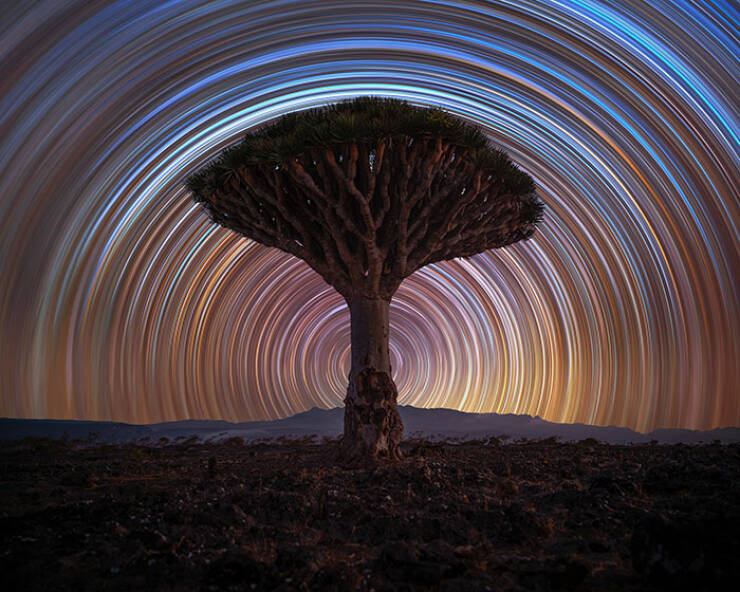
"Dragon Tree Trails" By Benjamin Barakat
"A solitary dragon tree stands tall in the heart of Socotra’s Dragon Blood Tree forest – an otherworldly landscape unlike anywhere else on Earth. The final image is composed of 300 individual exposures."
Taken with a Sony Alpha 7 IV camera, 24 mm f/2.8, ISO 400, 30-second exposure.
Location: Firmihin Forest, Hidaybu District, Yemen, 13 March 2024
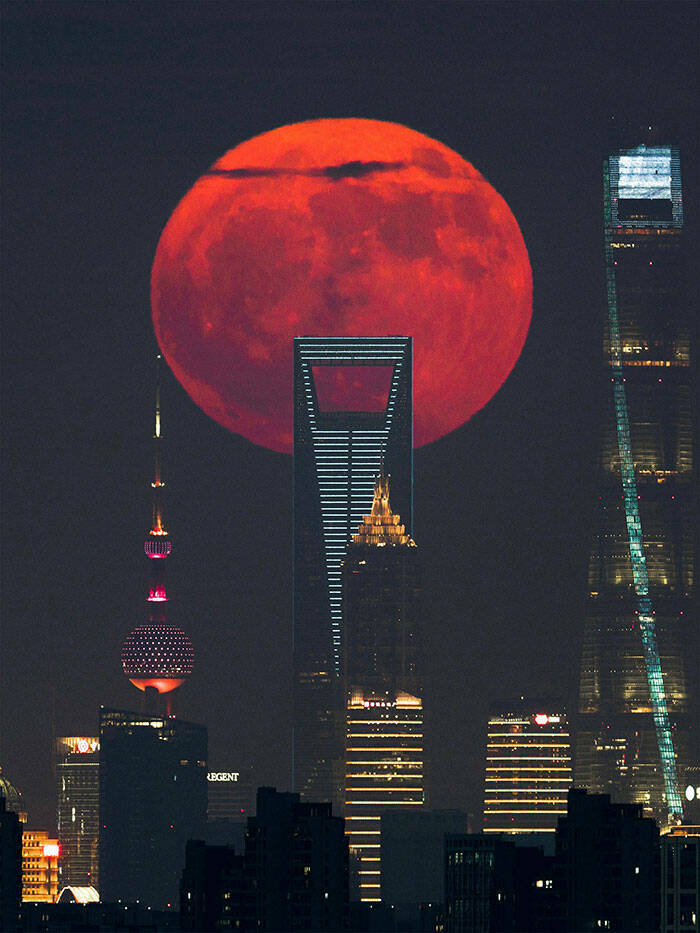
"Blood Moon Rising Behind The City Skyscrapers" By Tianyao Yang
"This photograph captures a red Full Moon rising beside Shanghai’s tallest skyscrapers in Lujiazui. Taken from a distance of 26.5 km (16.5 miles) from the skyscrapers in a single exposure, this image’s alignment took five years of planning. The Full Moon appears perfectly positioned next to the illuminated skyline, creating a striking contrast."
Taken with a Sony ILCE-7RM4 camera, 600 mm f/4, ISO 250, 1/10-second exposure .
Location: Jiading District, Shanghai, China, 21 July 2024
"Total Solar Eclipse" By Louis Egan
"This 22-megapixel panorama shows the different stages of the full solar eclipse, with a high dynamic range (HDR) image of totality in the middle. This reveals both the bright corona and finer details otherwise lost in standard exposures. The final image uses approximately 200 images with varying exposure times to create a HDR totality, before combining everything together."
Taken with a Canon EOS 60D camera, SWSA 2I mount, Sigma 70-300 DG lens, Baader solar filter, 300 mm f/6.3, ISO 100, approximately 1,200 x 1/200-second exposures and 200 x 1/25-second exposures.
Location: Coaticook, Quebec, Canada, 8 April 2024
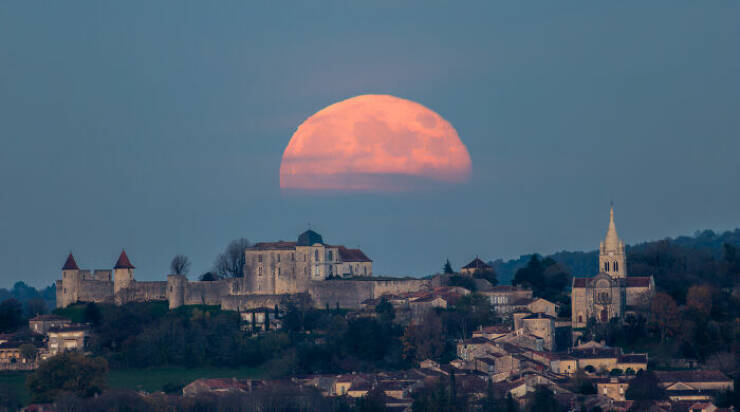
"Moonrise Over Villebois-Lavalette" By Flavien Beauvais
"This unique photograph was taken 6.4 km (4 miles) from the château of Villebois-Lavalette, just north of Bordeaux. The distortions are related to the distance between the imaged Moon and the foreground but also with respect to the atmospheric disturbance, hence the curves on the surface of the Moon."
Taken with a Canon EOS R7 camera, Sigma 150-600 mm lens at 600 mm f/6.3, ISO 2,500, 1/50-second exposure.
Location: La Font Aride, Saint-Amant-de-Montmoreau, France, 16 November 2024
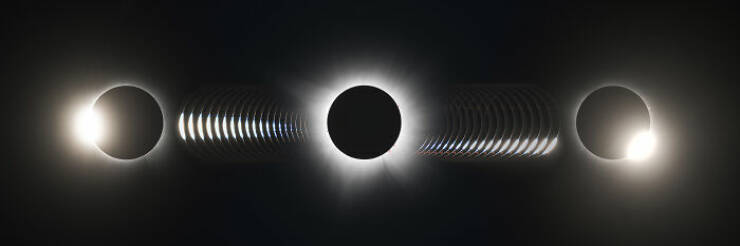
"Progression Of Baily's Beads" By Damien Cannane
"Baily’s Beads are bright spots around the Moon during a solar eclipse that are caused by sunlight passing through lunar valleys. This composite shows the progression, from left to right, from the first ‘diamond ring’ – a moment when one last bright point of sunlight shines beside the faint corona, resembling a diamond on a ring – fading through Baily's Beads into totality and beyond until a 'diamond ring' occurs again as the Sun starts to reappear. "
Taken with a Sky-Watcher Evolux 62 ED telescope, Celestron NexStar Evolution mount, ZWO ASI2600MC Pro camera, 360 mm f/5.8, Gain 100, Diamond Rings: 200 x 1/ 3-second exposures Baily's Beads: 400 x 1/ 6-second exposures, Totality: stack of 7 x 1/400-second exposure.
Location: Dexter, Missouri, USA, 8 April 2024