1
Online vs. Live Poker Strategies
Online and live poker follow identical rules but demand distinct strategies. Professionals who switch between formats quickly realize that timing, information flow and player psychology change dramatically. In online rooms, hands are dealt every 20 seconds, while in live settings, the pace slows to about 25 hands per hour. These tempo shifts influence both decision-making and emotional control.
How Game Environment Shapes Strategy
Every poker setting creates its own rhythm. At Spinsy Online Casino, players can join multiple tables simultaneously, using statistics and tracking software to gain an analytical edge. Live poker, in contrast, relies on physical tells and in-person observation, making concentration and patience essential.
Online platforms often use random number generators (RNGs) licensed by authorities such as the Malta Gaming Authority or the UK Gambling Commission to ensure fairness. Live casinos, meanwhile, employ certified dealers trained to manage decks and verify bets manually. Both systems maintain transparency but cater to different player profiles.
Table Comparison
To understand these distinctions, it’s useful to see how core strategic factors differ across formats.
2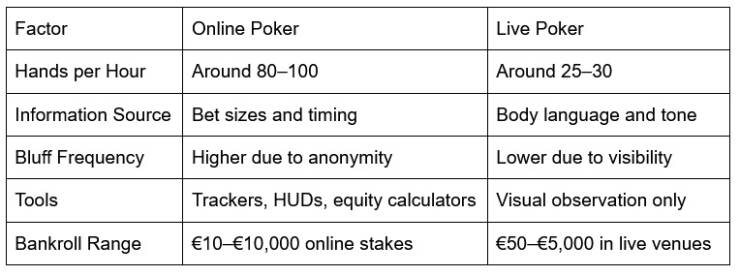
The variety of tools and data access makes online poker more analytical, while live play emphasizes instinct and situational awareness.
Bankroll Management Across Formats
Bankroll strategies must adapt to variance levels. Online games produce higher hand volumes, meaning swings occur faster. A typical recommendation is to keep 50–100 buy-ins for online play, while 20–40 may suffice in live settings due to slower pacing and fewer all-ins.
For example, an online grinder at €0.25/€0.50 blinds should hold at least €2,500 as a safety net. In contrast, a live €1/€2 player might comfortably operate with €1,000. Maintaining discipline between sessions prevents emotional tilt, one of the most common reasons beginners lose consistency.
Reading Opponents and Gathering Information
Online Opponents
Online environments strip away visual data, leaving digital breadcrumbs. Players study:
- Bet sizing trends: Consistent overbets often signal aggression.
- Timing patterns: Instant calls can indicate draws or medium hands.
- Chat behavior: Silence or sudden talkativeness may reveal tension.
Advanced users rely on heads-up displays (HUDs) to record statistics such as VPIP (voluntarily put money in pot) and PFR (pre-flop raise percentage). Over thousands of hands, these metrics expose playing styles.
Live Opponents
In-person reads demand observational precision. Common live tells include:
- Shaking hands: Often associated with genuine strength, not nerves.
- Prolonged eye contact: Typically a bluff attempt.
- Chip hesitation: Suggests calculation of risky bets.
Seasoned players keep mental notes, correlating each physical tell with past results. Unlike online tracking, this process requires memory and attention, skills honed over time through practice.
Adjusting Bet Sizing and Table Image
Your reputation at the table affects how opponents react to your bets. Online, reputation spreads through consistent patterns. Aggressive players known for frequent bluffs may receive calls more often. In live poker, however, table image builds through body language and social interaction.
At professional tournaments, such as the European Poker Tour with buy-ins exceeding €5,000, live players often maintain neutral expressions to avoid giving away emotions. Online, successful regulars balance automated aggression with timing randomization—delaying certain moves to appear less predictable.
Speed and Focus Differences
Online Speed
Multitabling in online poker requires cognitive precision. Playing four to eight tables simultaneously compresses reaction times. Each decision window may last less than 15 seconds. To handle this, professionals use pre-flop charts and decision trees to standardize responses.
For example, they might follow preprogrammed ranges for opening from the cutoff or button positions. Automation reduces mental fatigue during long sessions, especially when grinding tournaments with over 1,000 participants.
Live Focus
In physical poker rooms like those in Las Vegas or Monte Carlo, the atmosphere introduces distractions—noise, lights and audience presence. Maintaining focus becomes part of the game. Experts often use structured breathing or mindfulness techniques between hands to preserve composure.
Average live sessions last four to six hours, making endurance as critical as strategy.
Role of Technology and Data
Online platforms revolutionized poker analysis. Databases like PokerTracker or Hold’em Manager allow users to store millions of hands and study patterns post-session. This quantitative edge has created an entire generation of data-driven players.
Live poker, though slower to digitize, now benefits from RFID (radio-frequency identification) technology in televised tables. Cards are tracked in real-time to display probabilities for spectators. This innovation enhances transparency and enriches audience understanding, though players themselves cannot access this information mid-hand.
Economic and Social Context
The economic structures behind both versions differ as well. Online rooms operate with lower overhead, offering micro-stakes tables starting at €0.01/€0.02. Live casinos bear physical costs—dealers, staff and rent—resulting in higher rake percentages, usually around 5%.
Socially, live poker retains a cultural charm absent from virtual play. The ritual of stacking chips, ordering drinks and engaging in conversation creates an atmosphere of camaraderie. For many, this human interaction defines the true essence of poker.
Online players, conversely, appreciate the anonymity and convenience of 24/7 access. A single session can attract competitors from over 30 countries simultaneously, creating global player pools.
Building Hybrid Skills
Modern professionals rarely specialize in only one format. They adapt strategies depending on setting, time constraints and personal temperament. The top earners—like those featured in online high-roller series exceeding €500,000 in prizes—study both digital data and live psychology.
To transition smoothly between formats, players record sessions, review decision points and evaluate tilt triggers. The key lies in understanding that online precision and live intuition are not opposites—they are complementary skills in a complete poker arsenal.