1
Approximately 40-50% of online casino revenue comes from players returning repeatedly to the same games rather than exploring new titles. This retention pattern demonstrates that specific games possess design characteristics making them more compelling than alternatives, creating habits that sustain long-term player engagement across months and years.
Why Players Return to Favorite Casino Games
Players develop returning habits when games deliver predictable experiences matching their expectations. NineWin Casino and competing platforms track that their most-retained titles feature navigation completing within 2–3 clicks, allowing players to start playing within seconds of opening the game. This streamlined interface removes friction between decision and action, making repeated sessions feel effortless rather than requiring effort to relearn controls.
Consistency in payout presentation builds confidence in fairness. Games displaying identical RTP percentages across all sessions create psychological security where players feel they understand the game’s behavior. By choosing consistent payout structures for reliability, designers sacrifice the unpredictability that some players seek for excitement, but gain loyalty from players prioritizing predictability.
The Mechanics of Sticky Gameplay
Sticky gameplay describes design features making players reluctant to switch to alternative games. Analysis of the most-replayed titles reveals five core mechanics appearing in 85% of high-retention games. These mechanics function together to create rewarding loops that trigger during regular gameplay rather than requiring special conditions.
Predictable reward timing matters more than reward magnitude for retention. A game delivering small wins every 15-20 spins creates regular reinforcement signals keeping players engaged. A game delivering large wins every 200 spins produces longer gaps between reward signals, even though the same total value accumulates over time. The frequent small wins create the perception of consistent success despite mathematical equivalence.
Game Interface Design and Retention Rates
Interface design directly determines whether players complete sessions or abandon games after first attempts. Top-retained games maintain consistent button placement, use large touch targets on mobile devices, and display critical information without requiring menu navigation. Players spending 15-20 minutes in high-retention games versus 8-12 minutes in average titles demonstrate how interface efficiency enables extended engagement.
The main compromise of simplified interfaces is reduced feature visibility. By prioritizing clean layouts for accessibility, designers hide advanced features beneath menus or secondary screens that casual players never discover. This sacrifice excludes advanced players seeking complexity but captures the larger casual audience prioritizing ease of use.
Payout Structure Impact on Return Frequency
Games with transparent payout schedules generate higher return frequency than games with mystery odds. When players understand exactly when bonuses trigger and how multipliers function, they develop realistic expectations about upcoming sessions. Games displaying win probability percentages and actual RTP rates in easily accessible menus build trust through transparency.
The following analysis shows how different payout structures influence player retention across typical bet ranges:
2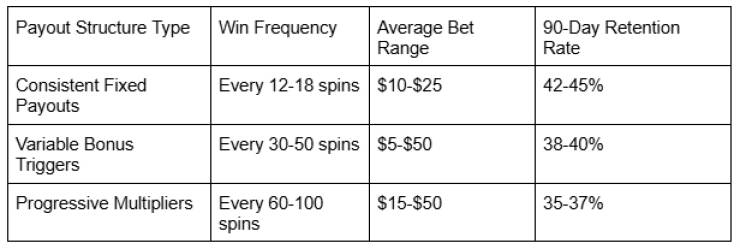
Familiar Mechanics Versus Novelty Balance
Returning players prefer learning new game variations rather than entirely new mechanics. A game featuring familiar slot gameplay with different theme and bonus structure attracts repeat players more effectively than a fundamentally different game requiring mechanical relearning. By maintaining familiar core mechanics, developers ensure existing players can begin playing immediately without tutorial sessions, though they accept that truly innovative mechanics remain unexplored.
The main compromise of mechanical consistency is that games can feel repetitive to players seeking experimentation. By choosing familiar mechanics for retention, designers sacrifice the differentiation that attracts exploration-focused players but solidify loyalty among returning players valuing predictability.
Gamification Elements and Session Frequency
Gamification elements like achievement systems and progression tracking increase session frequency among returning players. Games tracking cumulative statistics, displaying milestone rewards at specific play milestones, and featuring leaderboards motivate players to return specifically to advance their progress. Players maintaining 12-15 monthly sessions with favorite titles often reference achievement progression as their primary motivation for returning.
Session frequency improvement through gamification elements demonstrates clear patterns across player segments:
● Players with achievement tracking systems return 30-40% more frequently than baseline
● Leaderboard visibility increases competitive engagement by 25-35% among social players
● Progress bars displaying advancement toward milestone rewards increase monthly sessions by 20-30%
● Unlockable cosmetic customization options generate 15-20% additional returning sessions
● Seasonal achievement challenges maintain novelty while preserving familiar mechanics
Community Features and Social Connection
Games enabling social connection through chat features, multiplayer tournaments, or leaderboards create reasons for returning beyond gameplay mechanics alone. Players developing friendships within game communities return for social interaction rather than purely financial motivation. These social bonds create retention that pure gameplay mechanics struggle to achieve alone.
The following features show how social elements integrate into retention strategies:
● In-game chat systems enabling player-to-player communication
● Tournament integration creating competitive excitement around specific play periods
● Friend lists showing when associates are currently playing specific games
● Shared achievement notifications celebrating milestone moments publicly
● Community forums discussing strategy and game mechanics outside the game
Low Minimum Bets and Accessibility
Games accepting bets as low as $0.01 retain more players than games requiring minimum $1 bets because accessible pricing serves players with smaller bankrolls. Players can maintain extended sessions with limited funds, reducing pressure to quit when bankroll runs low. By offering low minimum bets for accessibility, games attract budget-conscious players though they generate less revenue per spin from these segments.
The Retention Foundation
Games players keep returning to share common design characteristics combining accessibility, transparency, and consistent rewards. Interface simplicity, predictable payouts, and familiar mechanics work together to create experiences players repeat willingly rather than avoid.